Showing posts with label Assignment 2 - One Acre. Show all posts

Friday, 12 September 2014

Assignment 2 (Final) - Kilcherg Kirche

Changes to original

I shot this assignment when I lived in Switzerland. Since I have moved back to the UK, it would be difficult to shoot additional images to strengthen the essay. Nevertheless, I have found an image from the original shoot that responds to my tutor's comment: include an image of the church with evidence of agriculture surrounding it (#1).

Images


My ‘One Acre’ is the Swiss Reform church at Kilchberg, 
a small lakeside suburb of Zurich, a window into
the values of its residents.
 
The church building, like much of Swiss architecture, is bland, reflecting
a preference for substance over style, function over form.
 

Time matters in Switzerland. The church clock
tower is commonplace, as are the chimes every
quarter of an hour, day and night. The Swiss prize
being on time for commitments and their watch
industry is a world leader. 


The needs of the collective are more important than those of the individual.
Most headstones are a uniform rectangular shape and inscribed
in a standard way - name of deceased, year of birth and death. Just so for 
Thomas Mann, the German novelist, the cemetery's most famous resident. 


Orderliness is cherished in Swiss life. So, in death as in life.
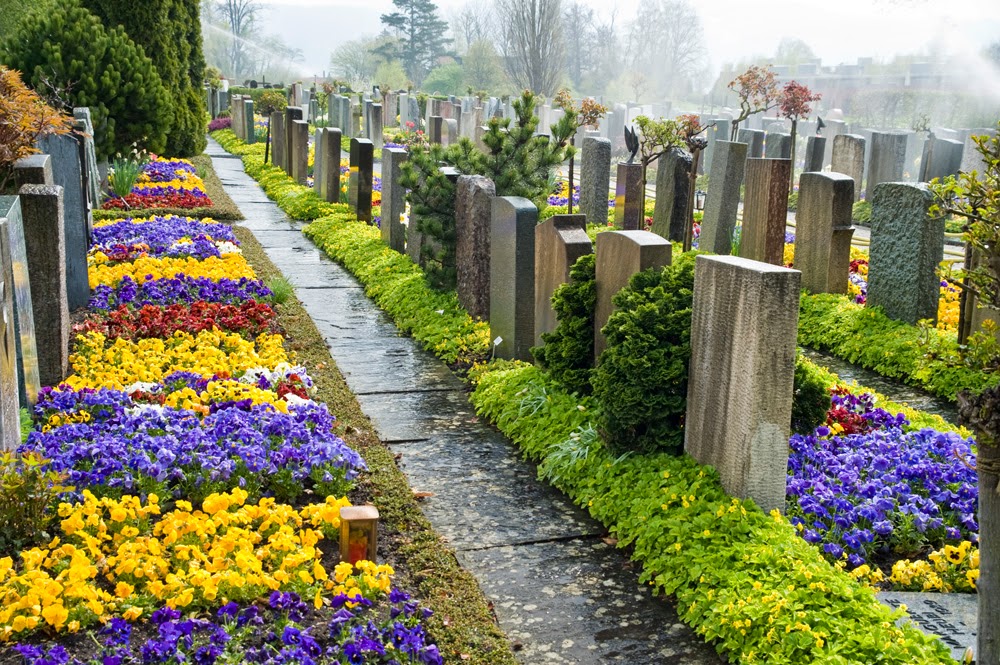
Most of the graves in the cemetery are laid out in a rectangular
formation, like a soldier on the parade ground


Nevertheless, despite the Swiss reluctance to stand out from the crowd,
some headstones are exceptions to this rule. This one is dedicated to a military
commander. The military plays a significant part in male society in Switzerland, even though the country is known for its neutrality in conflict.


Another exception to the rule of uniformity is this headstone
honouring the life of a 13 year old child, Walter Strauss who died in 1923.
The inscription 'his life of an edelweiss' suggests that he died in  a mountain accident.
Although Walter died 90 years ago, the gravestone has been maintained
immaculately. The Swiss sense of hygiene.
 
 
The church employs a team of
gardeners paid by public taxes. So, 40 years later this grave is bursting
with flowers, as if the funeral was only yesterday


Other than the gardeners maintaining the cemetery,
it is rare to see people, these two in conversation
being an exception


Tulips are allowed to stand tall, even if poppies
are not.


Water flows through Switzerland from its mountains to
numerous lakes and rivers. Its engineers pride themselves
on controlling these flows. So, no garden of rest
would be without its calming pool. 

Into Gods hands we commend our souls...


Tuesday, 22 May 2012

One Acre - Assignment 2

Requirement
12 photographs


Instructions

  • Select a small area of landscape of about 1 acre
  • Produce an essay on this area with a wide range of images, including 2 o 3 close-ups

Images and review


Images taken in 2010, whilst living in Switzerland. This is the assignment done first. Unfortunately, I have had no opportunity to return to this location to respond to the tutor's comments, except for another shots taken of the Church in its surroundings (image 1) which I have since added to the blog (see below).


Tutor's comments


Overview

Some thoughtful images here...I identify with some of the things in your images, some
of the habits and peculiarities of the Swiss and their country are quite unlike her neighbours...telling that this can be explored in quite a confined area, like a church and its yard...good observational skills


Further study
Look at these landscape practitioners. They all explore aspects of land and/or identities, without being pre-occupied with aesthetics or the picturesque:


  • Robert Adams
  • Fay Godwin
  • Simon Norfolk
  • Ingrid Pollard
  • Martin Parr
  • Simon Roberts


1. Church 
My ‘One Acre’ is the Swiss Reform church at Kilchberg, a small lakeside suburb of Zurich, a window into the Christian and other values of its residents.


...would have been good to see some of the agriculture juxtaposed with the church...nothing really critical here unlike other images.


Originally taken for the exercise on perspective,
this image shows the Church at end
of the path and amid the surrounding
growing wheat fields in June


2. Tower 
The Swiss generally prefer substance over style in way that goes deeper than the reformist Protestant tradition. No surprise then that the church building, like so much of Swiss architecture, is bland. 


3. Clock
If Christianity is the main religion, then measurement and keeping of time stands not far behind. The clock tower is commonplace, as are their chimes every 15 minutes, day and night. The Swiss hate being early for an event nearly as much as being late.


4. Thomas Mann 

Only the rebellious few stand out from the crowd, reassurance against the anxiety of being ostracised. In keeping with this, most of the headstones in the grave yard are uniform in shape (rectangular) and inscription (the name of the deceased and his or her year of birth and death). Just so for Thomas Mann, the German novelist, the cemetery’s most renown resident.


5. Headstones in a row

A sense of order is much prized in Swiss life. Stereotypically, this virtue makes the trains run on time, lest chaos strikes. As in life, so in death. Most of the graves in the cemetery are laid out to a precise pattern.


... wonder if you could have photographed the regimented graves even more regimentally?
In terms of sequencing, I like the way this image is place between the 2 'tall poppies'


6. Military presence 


Despite the Swiss reluctance to be a tall poppy, a handful of graves have spectacular headstones. This one commemorates an infantry commander. The military plays a significant part in Swiss life, much more a network than a fighting force. But how glorious is war, especially from 20th century onwards? The forging of national character or the slaughter of innocents?


7. Child death 
Again this grave of a 13 year old child is another justified ‘tall poppy’. Unusually, it has an inscription: ‘His life for an Edelweiss’. This and the shape of the headstone suggests that Walter Strauss died in a mountain accident. The Swiss sense of hygiene is also at work here. The headstone is almost 90 years old, yet it looks like new. Who is still alive in 2010 who would have known him? 


8. Flowers 


Which relative is planting this rich array of flowers at this grave nearly 40 years after the death of Milli Naegli-Zoebeli? None, probably. The church employs a squad of gardeners that keep the cemetery looking like a Victorian public park. The money to pay for this comes from the public taxes.


9. Visitors 
In fact, other than the gardeners it is unusual to see visitors to the cemetery. These two men talking in the garden of rest are a rare sight.


10. Tulips
Tall poppies may be shunned but tall tulips not.


11. Water 
Water flows through Switzerland from its mountains to numerous lakes and rivers. Its engineers pride themselves in controlling these flows. So no garden of rest would be without its calming pool.


12. Reach up 
Finally, in death ’into Gods hands we commend our souls’. This statue with arms outstretched stands at the entrance to the cemetery and reflects the aspiration that the souls travels to heaven above and not to hell below.